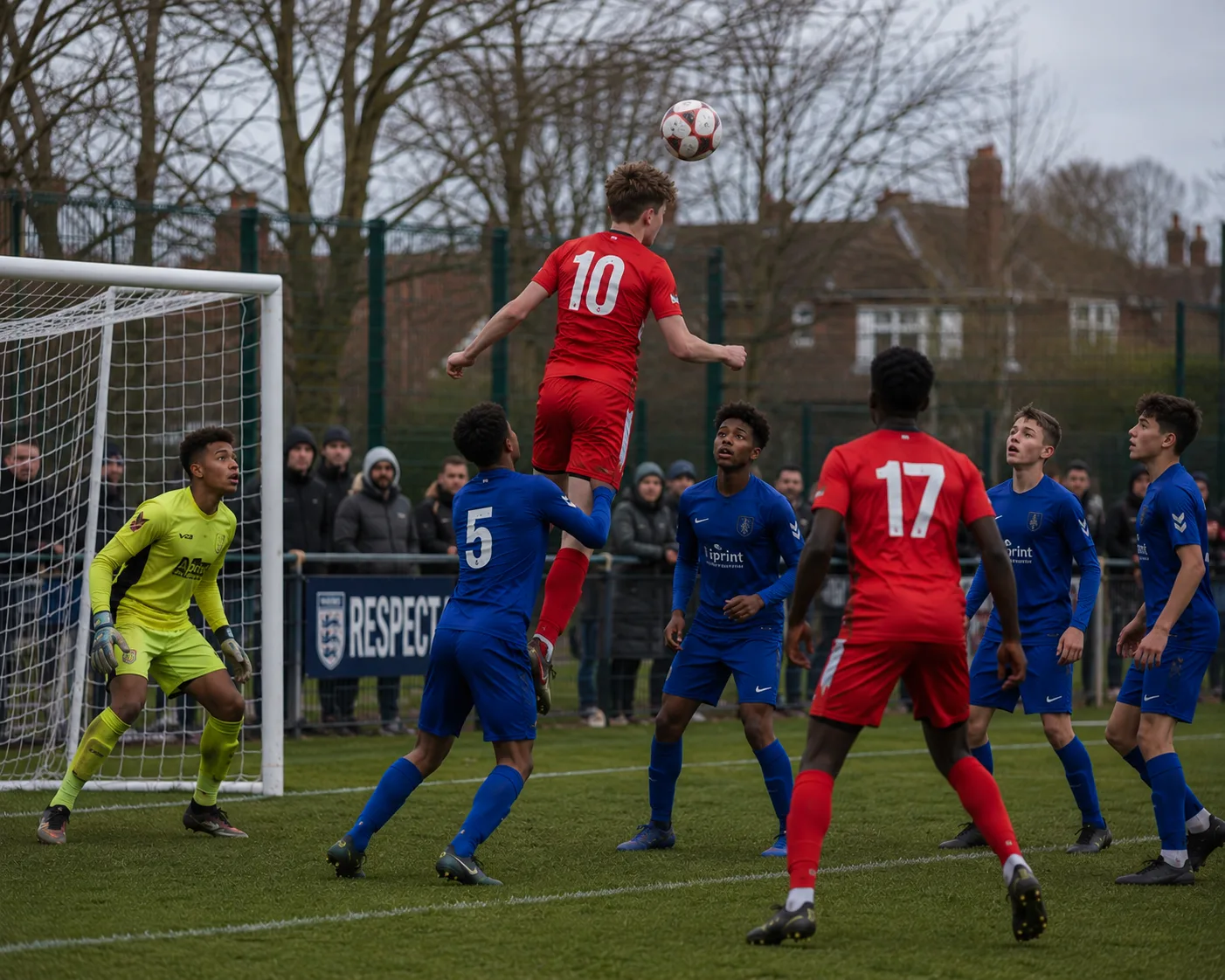
Last season at U12 was the first year heading the ball really mattered for us as a team. The ball gets heavier, the corner deliveries come in flatter, and the centre-halves at that age start to genuinely attack the ball — properly competitive. Across the whole season we didn't concede a single goal from a corner.
I know that because Trac tracks goals against, the phase they came from, and who was on the pitch. No spreadsheet. No memory. I just looked at the end-of-season archive and the number was there.
I didn't force every lad to learn to head the ball
Some of them aren't quite there yet. Some of them aren't capable of it yet at this age. That's fine. The whole philosophy of this team is play to your strengths — heading is just another skill that fits inside that rule.
So instead of running a session where every player practises heading until they're sick of it, I worked out which lads had it naturally, made sure they were in the right places at the right time, and let the rest do their jobs around them.
This is the principle in action: don't drill skills they don't have. Build the game around the skills they do have.
Defensive corners — the routine
Three rules. Everyone on the pitch knew their job by the second half of the season.
Mason comes back
Our striker. Also one of the best headers in the squad. I'd rather have him 80 yards from his usual position for thirty seconds and win the first ball than leave him up top to wait for a clearance that might never come.
Best headers mark space, not players
The lads who can actually attack the ball are positioned where I expect the delivery to land — near post for a flat in-swinger, six-yard box for a deeper one. Their job is to attack the ball, not babysit a runner.
The rest zone-mark the runners
If you can't head it cleanly, you're not going to win that first contact anyway. So your job is to make sure no opposition player gets a free run on the second ball.
Jack in goal — coming and punching
The other massive piece was Jack, our keeper. Most U12 keepers at this level either stay on their line and pray, or come for everything and miss half of them. Neither is good enough.
I worked with Jack on one specific thing: knowing when to come, and when he comes, making clean contact with the punch. Not catching — punching. Catching at U12 from a corner is high-risk, you're competing with five other bodies and the ball is moving fast. A clean two-fist punch travels 25 yards and the danger is dealt with.
By the second half of the season Jack was decisive. Either he calls it and comes, or he stays and trusts the lads. No half-coming. Half-coming is what gets you a goal.
Attacking corners — best header attacks the back post
My strategy attacking corners was the opposite of what most coaches teach. Get the best header of the ball to attack the back post, not the near post.
The logic is simple: every other lad on the pitch — both teams — gravitates toward the ball. They all crowd the near post and the six-yard box. So if your in-swinger gets a yard or two past the keeper, the back stick is virtually an open net.
We had two in-swinger options:
- Oscar from the right corner, left-footed in-swinger.
- Joseph from the left corner, right-footed in-swinger. When Joseph takes, Mason and big Harry our centre back come up from the middle.
Both deliveries swing in toward the goal. The lads in the box do their jobs. The best header peels off the crowd and arrives at the back post a beat late. If the delivery's right, that's a tap-in.
Why back post, not near post
Three reasons we abandoned the conventional near-post flick-on.
Everyone gravitates to the ball
Both teams crowd the near post and six-yard box. The back stick gets left alone. If your delivery clears the first wave, your back-post runner has a yard of space nobody else is contesting.
Late arrivals beat set defences
Defenders try to mark zones at corners. A late back-post run ghosts in behind their lines — they can't drop with you and watch the ball at the same time.
In-swinger does the work
Left foot from the right corner, right foot from the left. The ball bends in toward goal. The keeper has to commit or stay — either way, a clear back-post runner is in business.
Joseph and a Casemiro-style sense of timing
Joseph is our best header. Not because we drilled it. Not because he's the biggest. He's fearless, and he has this natural Casemiro-style sense of timing — knowing the exact moment to start the run so he arrives with the ball, not before it, not after it.
You can't teach that. You can either build a routine around it or ignore it. We built a routine around it.
The Esperanza goal
Third-to-last day of the season. Home to Esperanza. Stubborn at the back, hard to break down. We needed a goal and we weren't creating much in open play.
The Saturday before, training had been all back-post arrivals. Just movement — the run, the timing, the angle of approach. No heading drills. We just walked through it again and again at full speed: corner taken, big bodies attack the near, Joseph ghosts late into the back stick.
Sunday at home to Esperanza, in true Arsenal-this-season fashion: corner, big bodies do their job, Joseph ghosts in at the back stick and taps it in. 1-0. Vital three points.
It was a volley, not a header. But the movement is what mattered. The header would've been a bonus. The arrival in space is what we'd actually trained.
Practice the movement, not the heading
Three rules I keep coming back to whenever heading shows up in a session.
Train the movement first
You can't do repetitive heading. So most of the session is walking through positions and timings — runs, angles, who arrives where. The heading is the last 10%.
Short bursts only
Heading reps come in 3 or 4 at a time, then off. Anything more and concentration goes — and that's when you get bad technique or, worse, a clash of heads.
Always a break after a big one
If a lad's gone up and properly contested a header, give them a few minutes. Walk it off. Hydrate. Next round of reps starts with someone else.
What the Trac data showed
End of season, I opened the archive and pulled up goals against. Trac tags the phase for every goal — open play, free kick, corner, penalty, own goal. Zero goals against from a corner. Across the whole season.
You don't get that without the routine being clear and the right players being in the right places. And honestly — without Trac I probably wouldn't have known. I'd have remembered the few we conceded from set-pieces and assumed it was a problem. The data showed it wasn't, and that's the kind of thing that quietly changes what you train.
The takeaway
Two principles do all the work in this post.
Play to your strengths
Don't force every player to learn every skill. Find the headers, put them in the right spots, build the routine around them.
Track it so you actually know
If you don't have data on which phase your goals against come from, you're guessing. Trac tags every goal as it goes in, so at the end of the season you can read the patterns.
What's next at U13
The heading problem changes shape at U13. Goal kicks travel further. Defenders clear further. Suddenly the ball is in the air in midfield, not just from set pieces — and the lad winning that second-ball flick-on, and the lad timing his run onto it, are deciding a lot of attacks.
So next season's focus is two things:
- Attacking flick-ons. Whoever's in the centre-forward channel goes up to win the first header. We're not asking them to score with it — we're asking them to set the right angle and pace for the runner.
- The timing of the second-ball runner. Arrive on the bounce, not behind it. That's a movement drill, not a heading drill. Same lesson as the back-post arrivals — practice the run, not the head.
Different problem, different drills. But the corner routine stays as is. It worked.